
By Kirsten Han
“Prisoners shouldn’t be comfortable, because if they were, then where would the punishment be? Where is the deterrent effect if people aren’t frightened onto the straight-and-narrow by harsh prison conditions?”
The dominant narrative about incarceration is that everyone in prison is a criminal who doesn’t deserve our concern or sympathy; anything and everything that they experience within prison is what they deserve for breaking the law.
People expect, even want, prisons to be terrible places of suffering.
But what we do actually want for society in the first place, and does incarceration help us achieve that?
“Repress, Oppress, Suppress”
The Transformative Justice Collective (TJC) interviewed 35 formerly incarcerated people who have experiences life in prison or state-run Drug Rehabilitation Centres (DRCs). These accounts are presented in an extensive report on conditions in Singapore’s prisons released. Although the Singapore Prison Service (SPS) brands itself as “Captains of Lives” who “rehab, restart, renew” the lives of those under their custody, what TJC found was a very different picture.
As one formerly incarcerated person told TJC:
“You don’t break a person down before you build them up. You empathize with them, you feel what they’re going through, from there, both of you work together. You cannot break him down, make him feel like a total piece of shit and then say, ‘Let’s start working on him now.’ I mean, that’s just not how it works. In prison, or anywhere else I feel. That’s not how it works. The prison likes to say they are ‘Captains of Lives’. ‘Rehab, Renew, Restart.’ Actually, it’s more like repress, oppress, suppress.”
Despite the public emphasis on rehabilitation, not everyone in prison has access to rehab programmes.
The prison uses an assessment tool to decide if someone can be enrolled in such programmes:
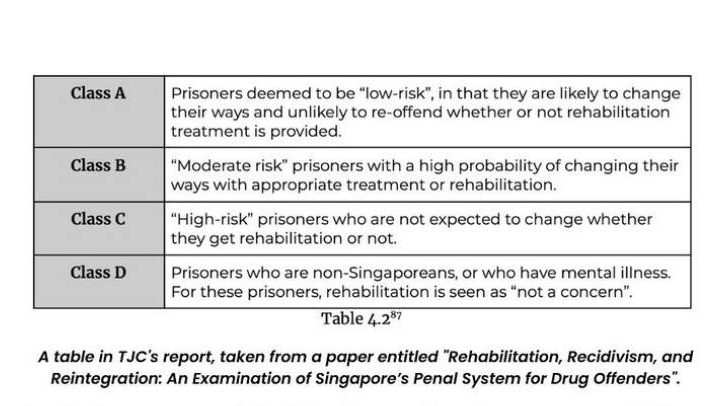
In their paper, sociologists Ganapathy Narayanan and Lian Kwen Fee observed that this can lead to systematic discrimination against minority prisoners (who form the majority of the penal population):
“…the higher recidivism rate among the Malay and Indian offenders relative to the Chinese has led to the exclusion of minority inmates from participation in rehabilitative programmes. While there is no explicit discrimination based on race per se, prison authorities are reluctant to extend rehabilitative opportunities to ethnic minorities who are perceived to be recalcitrant offenders.
What does “Justice” mean to you?
Research indicates that people can get stuck in incarceration cycles, where they struggle to reintegrate after leaving prison, end up committing an offence and get imprisoned again. Upon release from prison, people have to struggle with stigma, strained or damaged relationships, and additional barriers to employment. After incarceration, they struggle so much more with financial issues and finding decent employment making their lives even worse than before.
A study done in Singapore with 230 people who had been incarcerated found that a person was 3.51 times more likely to reoffend with every incarceration.
In other words, the status quo is not only working, it’s also causing more harm.
We should not be doing things that inflict more pain to our society.
Rethinking Capital Punishment, Rehabilitation & Justice
Singapore has followed the current criminal punishment model for so many years, and thousands of people and their families have been trapped in a vicious cycle of criminal punishment, incarceration, pain and trauma.
If we want a society in which families thrive, harms get repaired, and people are given the support they need to live well and heal from their pain, then we urgently need to be doing something differently.
Our focus for a safe society should be on reducing harm and suffering, and on preventing harm from being done rather than doling out punishment after the fact.
The very premise and setup of Singapore’s prison and compulsory drug detention system is antithetical to rehabilitation and healing.
Given these facts, can our society stand with each other and shift it’s lenses towards systems that work rather than punishment when something wrong or bad happens?
 Transformative Justice Collective