Singapore is increasingly alone in the world in its use of the death penalty, in the company of authoritarian regimes like Iran, China and Saudi Arabia. Even more shamefully, among those who retain it, Singapore is one of the fiercest and proudest defenders of the death penalty.
Academic and activist Dr Mai Sato scathingly debunks the “proof” the Singapore government likes to brandish to claim that the death penalty is an effective deterrent whenever Singaporeans or international experts criticise the death penalty. As she puts bluntly, “Whom and what purpose the death penalty serves in Singapore remains unanswered”.
To be clear, TJC rejects the death penalty even if one could somehow prove its “deterrent” effect. The deterrence argument is deeply immoral because it implies that inflicting incredible violence on some people is worth it to scare other people into not committing the same violence. But it is still important to expose that the government’s two main claims about the death penalty (1. that the death penalty is a deterrent and 2. that there is strong public support for it) are false, and do not stand up to scrutiny. These claims are disingenuous and meant to manipulate the public into accepting the death penalty, and do not represent or protect the public.
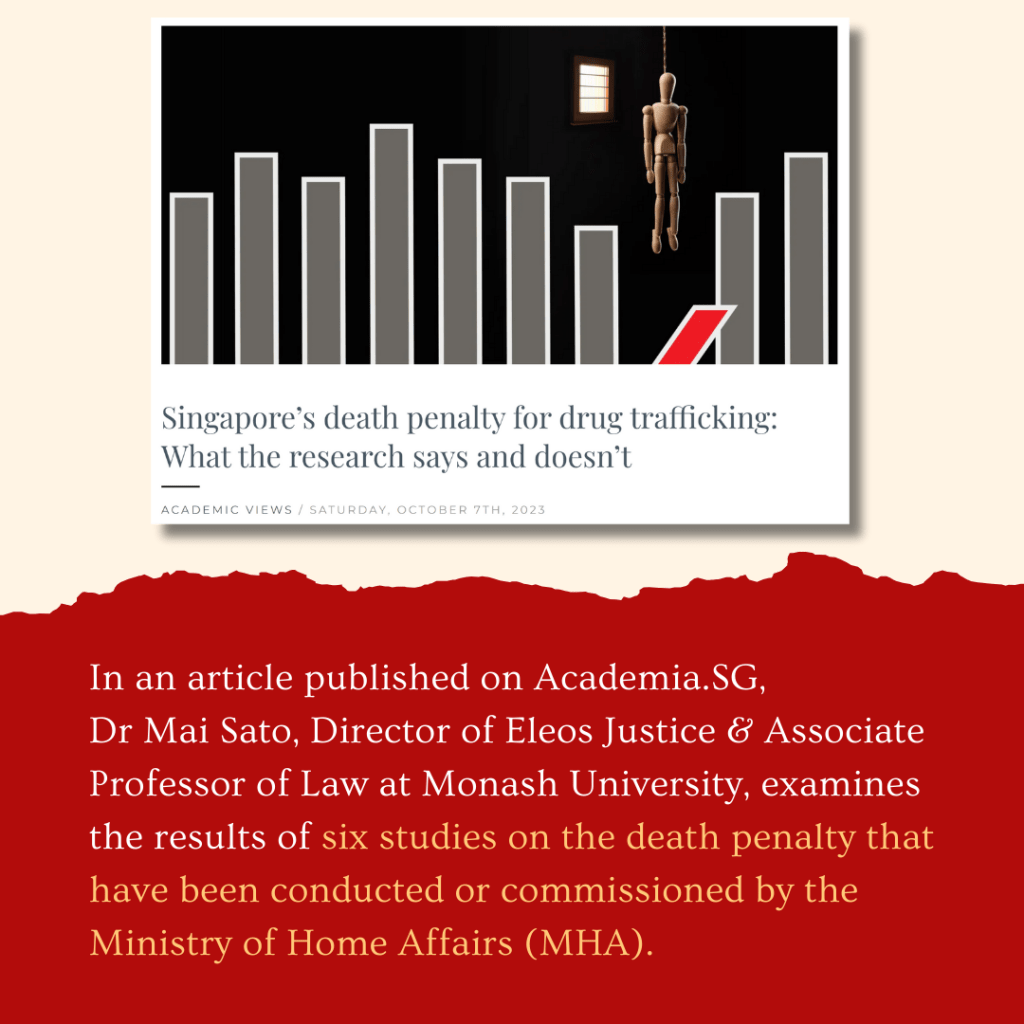
In an article published on Academia.SG, Dr Mai Sato, Director of Eleos Justice & Associate Professor of Law at Monash University, examines the results of six studies on the death penalty that have been conducted or commissioned by the Ministry of Home Affairs (MHA).
After thoroughly examining the results of said studies, Dr. Sato concludes that their findings do not support the death penalty in the way the government claims.
If anything, they point to a lack of evidence to justify retaining a punishment as extreme and violent as the death penalty.
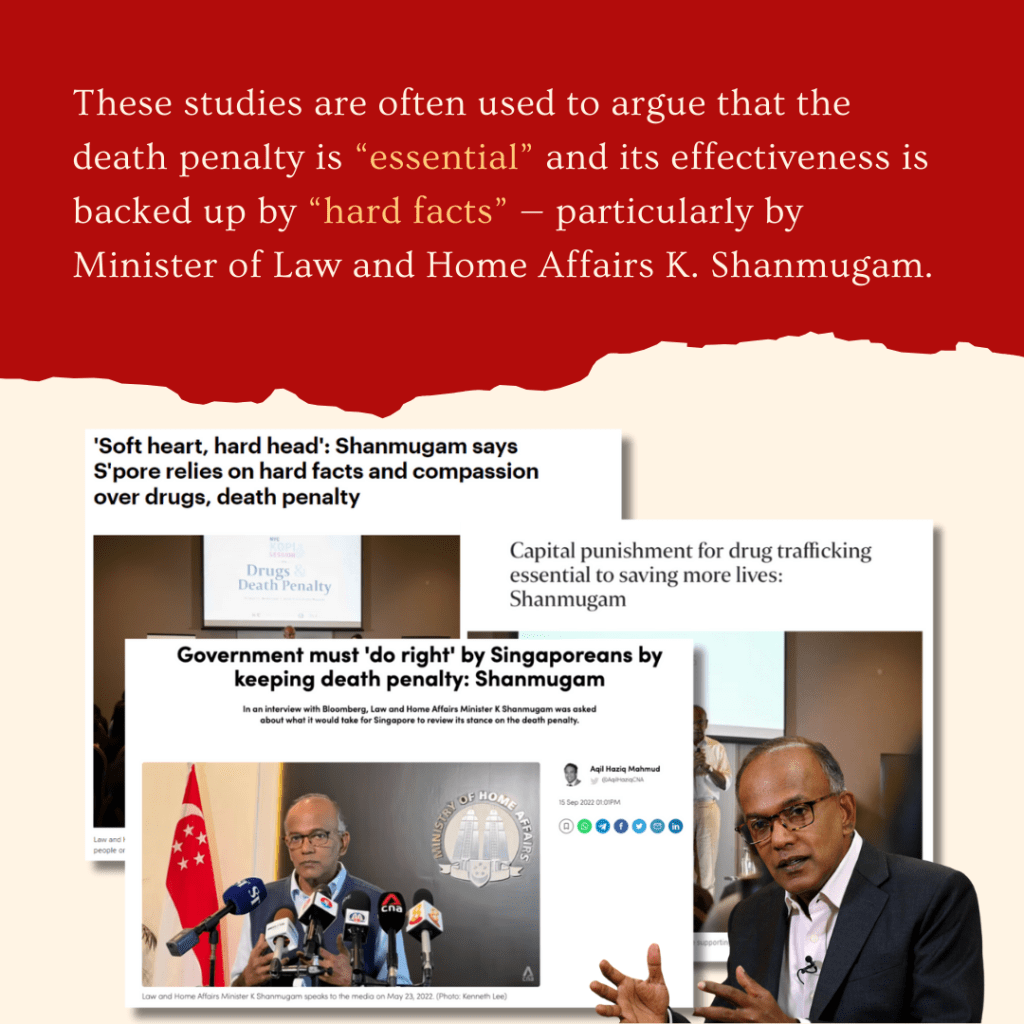
These studies are often used to argue that the death penalty is “essential” and its effectiveness is backed up by “hard facts” — particularly by Minister of Law and Home Affairs K. Shanmugam.
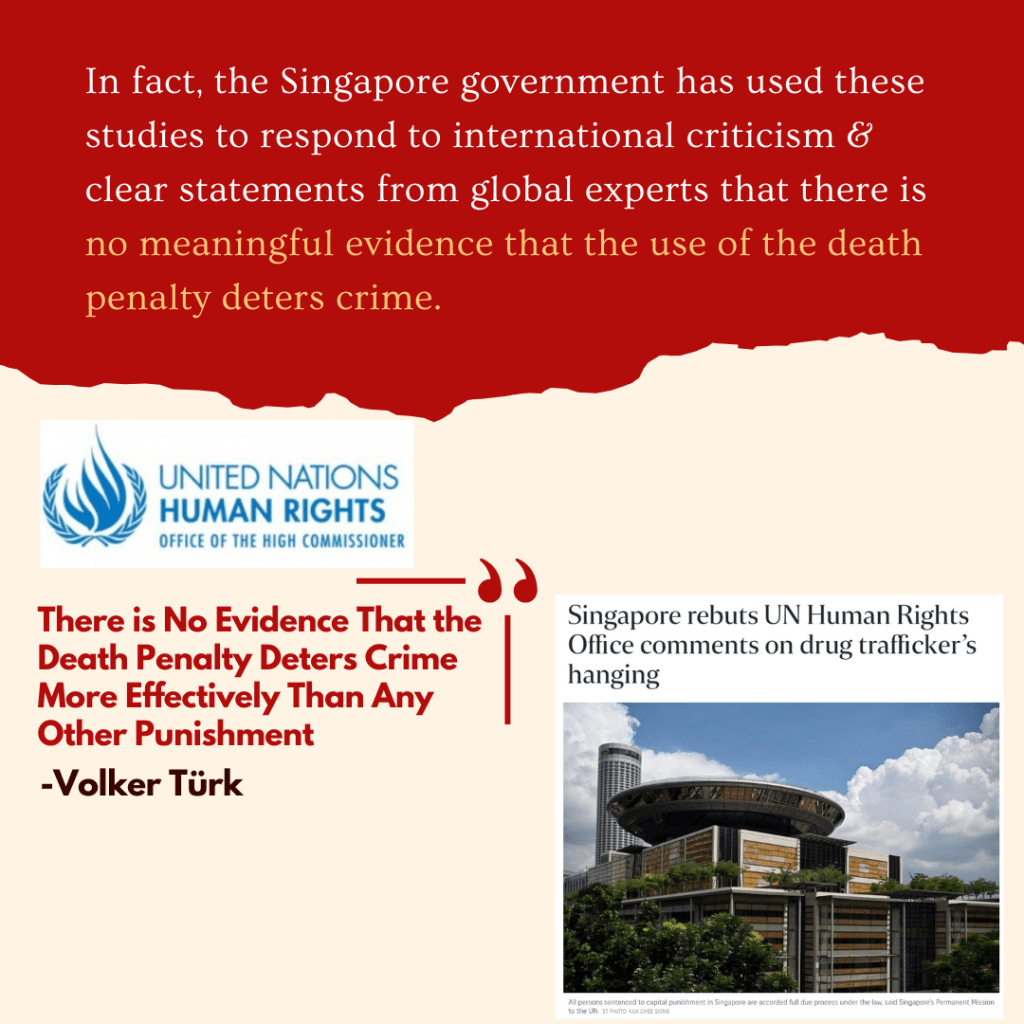
In fact, the Singapore government has used these studies to respond to international criticism & clear statements from global experts that there is no meaningful evidence that the use of the death penalty deters crime.
Year after year, the state continues to execute people, insisting over and over that such violence is a necessary evil.
Yet the evidence that they present to prove this necessity is deeply questionable, extracted from studies that an expert has found to be imprecise and methodologically weak.
In making empirically unsupported, problematic claims based on these studies, has the state fulfilled its responsibility to the public in justifying the disproportionate power it wields over us? Or does it simply hope that we will continue to believe these spoonfed myths about what keeps us safe?
If a necessary evil turns out to not have been necessary after all, then it is nothing but evil.
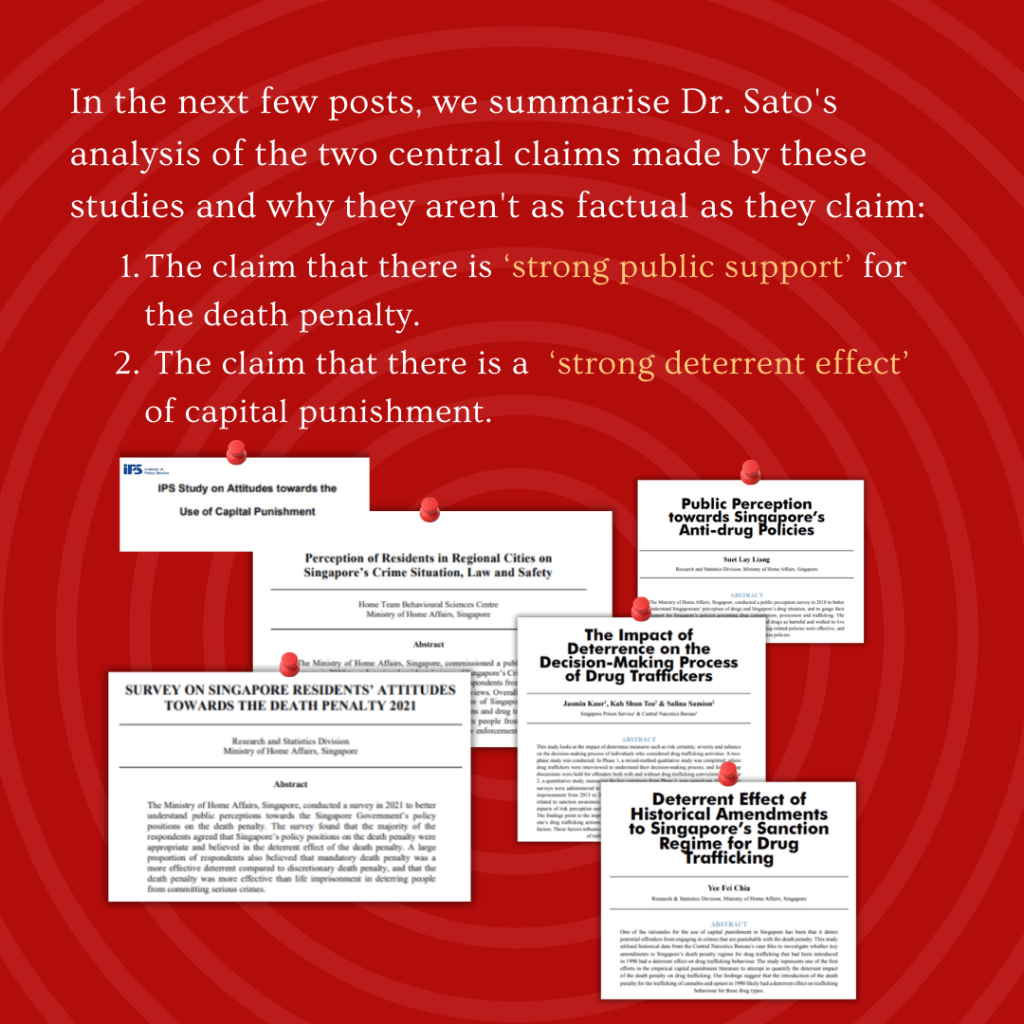
In the next few posts, we summarise Dr Sato’s analysis of the two central claims made by these studies and why they aren’t as factual as they claim:
- The claim that there is ‘strong public support’ for the death penalty.
- The claim that there is a ‘strong deterrent effect’ of capital punishment.
“The Singaporean public does not appear to be clamouring for the retention of the death penalty for drug trafficking. Whom and what purpose the death penalty serves in Singapore remains unanswered.”
Dr Mai Sato
 Transformative Justice Collective