The myth that the death penalty deters people from committing crime is the biggest argument that the Singapore government makes in favour of the death penalty. However, Dr Mai Sato analysed studies carried out by the Ministry of Home Affairs that claimed to prove the effectiveness of the death penalty for drug trafficking and found that the government’s very own studies show that NO such deterrent effect exists.
- Belief is Not Proof
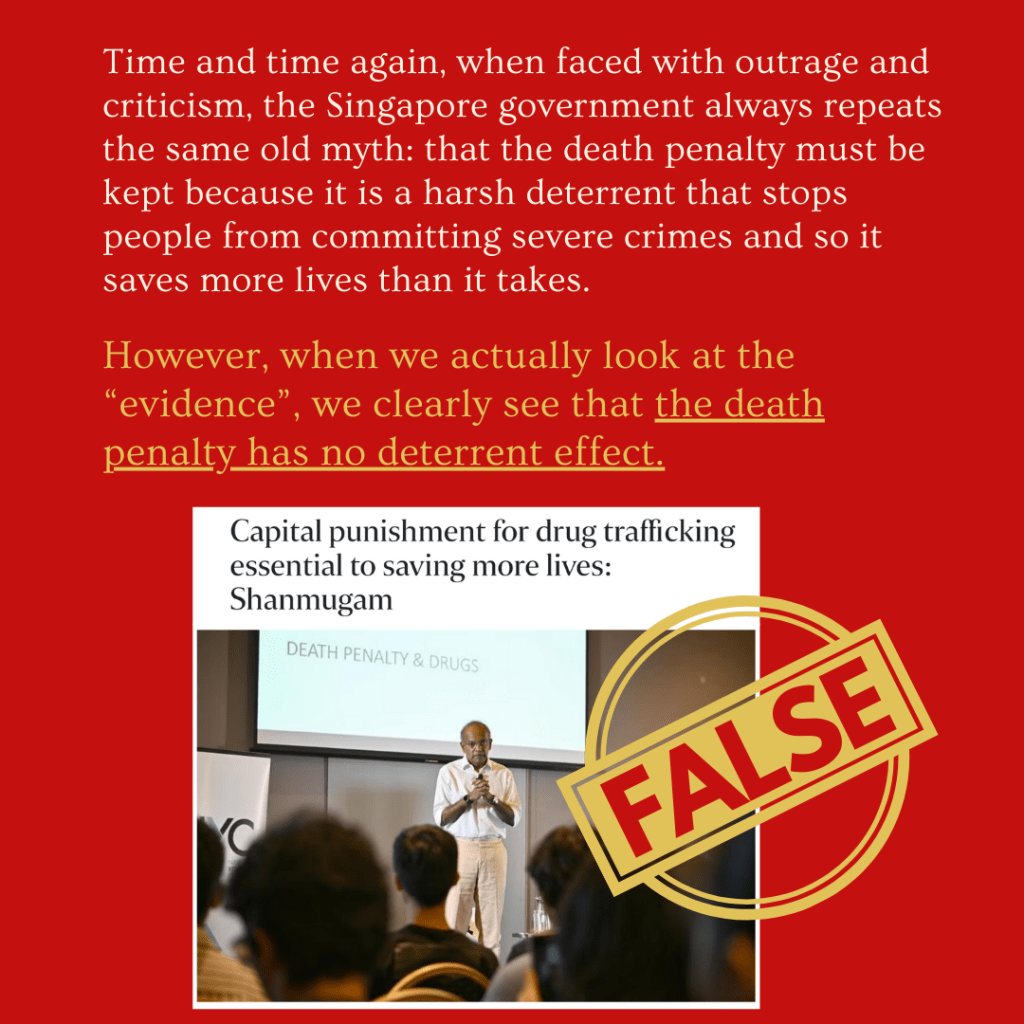
One study, cited by Minister K Shanmugam, claimed that 87% of people living in six unnamed regional cities “believed” that Singapore’s death penalty deterred drug trafficking. But deterrence is not a matter of people’s opinion. Just because some people believe that it works, doesn’t mean that the people who are put in a situation to break the law will actually change their behaviour.
Moreover, the target population of the survey is plainly wrong. The respondents of the survey don’t represent the views of people who are likely to be bringing drugs into Singapore, because their cities were chosen based only on the fact that a ‘significant’ volume of travellers from those cities visit Singapore. A more accurate research methodology would survey travellers who come from cities that most people convicted on drug offences in Singapore originate from.
2. The Rationality Assumption
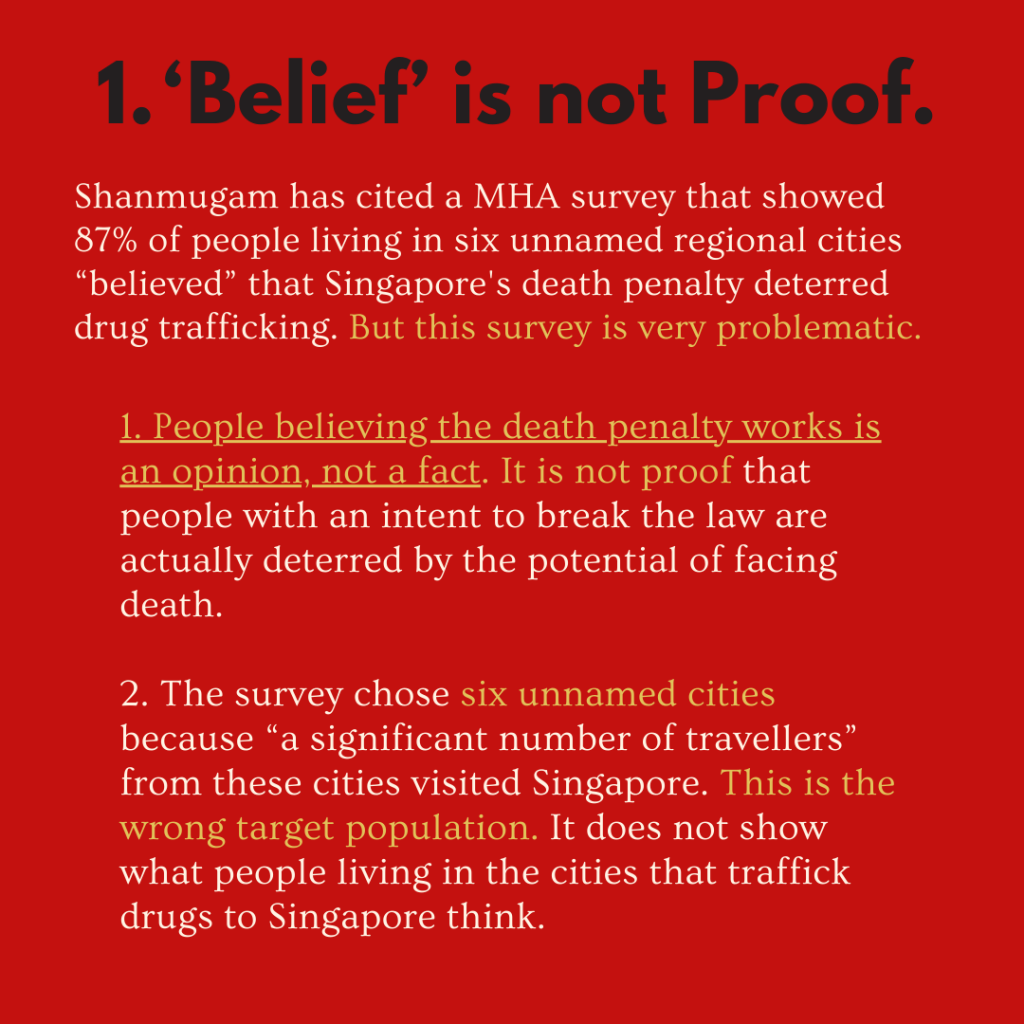
For deterrence to work, we must assume that individuals (a) have perfect knowledge of the consequences of breaking the law and their likelihood of being caught, and (b) are able to logically weigh the costs and benefits of their actions. But this theoretical thought process simply isn’t true of how people behave and think.
But another MHA study conceded that people convicted on drug offences often don’t rationally consider the potential consequences of their actions, be it due to external influences and stresses or because they act under duress or coercion. The study includes various quotes by these people that illuminate the various ways in which, despite knowing of the death penalty, they simply were unable to conceive of the eventuality that they could be caught.
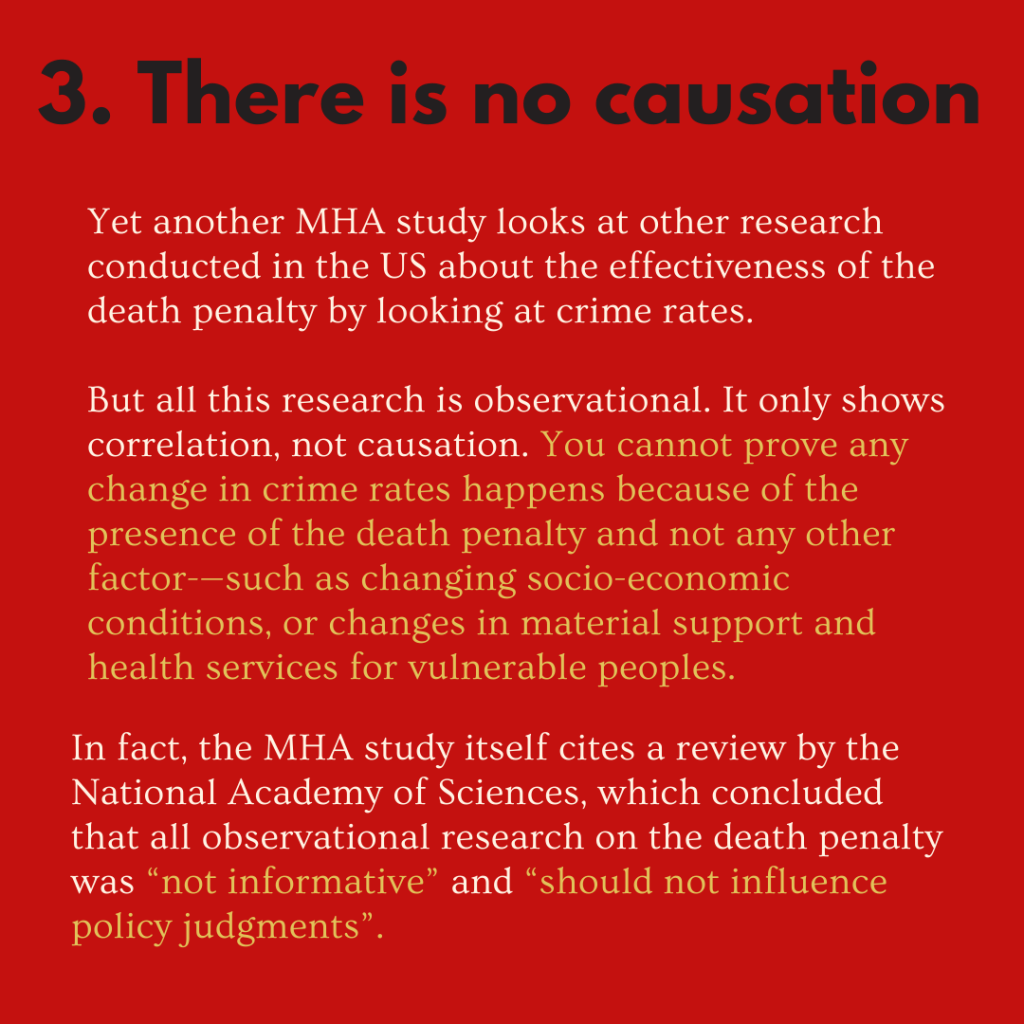
3. Correlation is not Causation
While another MHA study conducted a literature review on US-based research that cites a correlation between the death penalty’s presence and falling crime rates, these studies are deeply unscientific. As an overview by the National Academy of Sciences concluded, these observational studies are deeply flawed, because there is no way to prove that it was the death penalty, and not any other factor, that caused a change in crime rates. Nor is there any proof that the death penalty singularly stood out amongst other forms of punishment or redress as a particularly ‘good’ or ‘strong’ deterrence. Simply put: there is absolutely no proof it works.
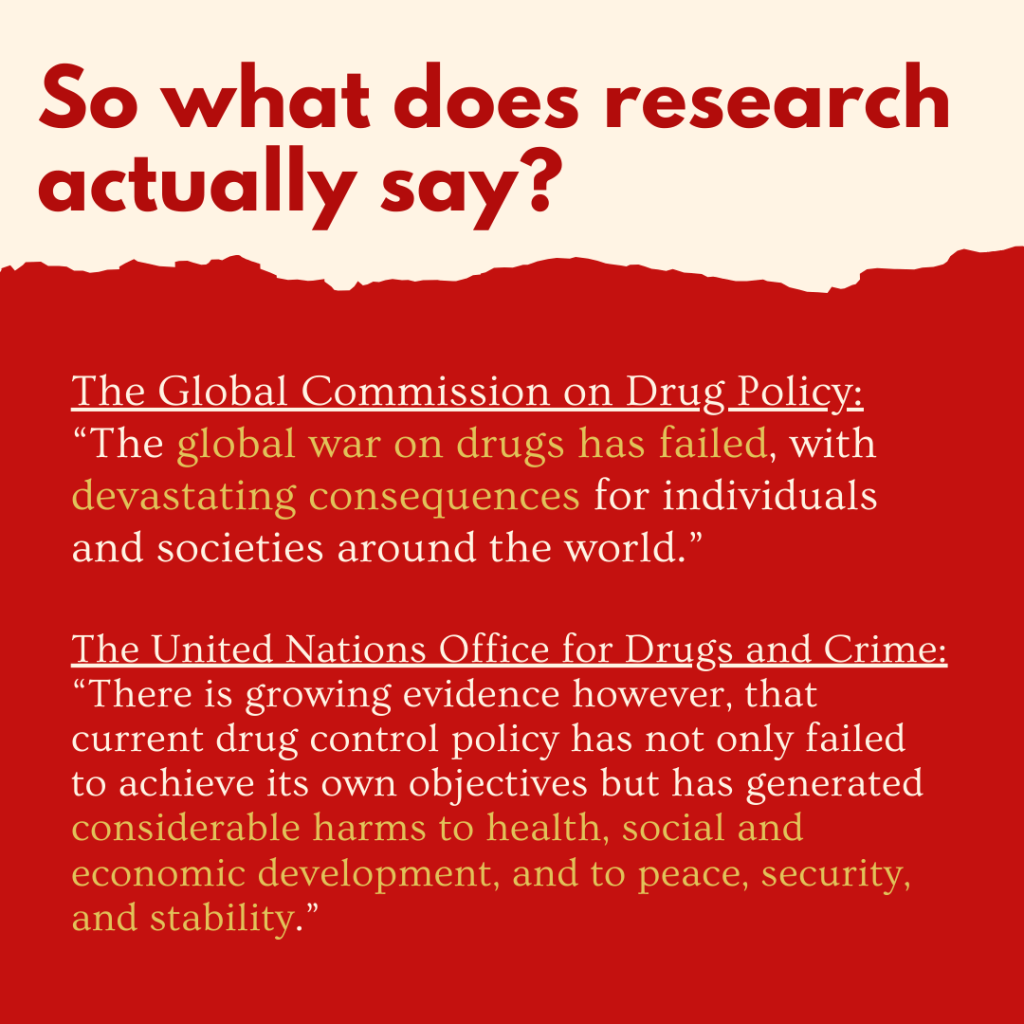
So what do we know? What is proven? Global research has increasingly validated the destructive effects of the global war on drugs–which has only strengthened illegal drug markets and prevented exploited and marginalised people from accessing treatment and help.
Minister K Shanmugam has claimed that if the government was not sure that the death penalty was saving lives, they would get rid of it. The evidence is damning–the death penalty does not save lives, it just takes more lives away. We must abolish the death penalty!

 Transformative Justice Collective