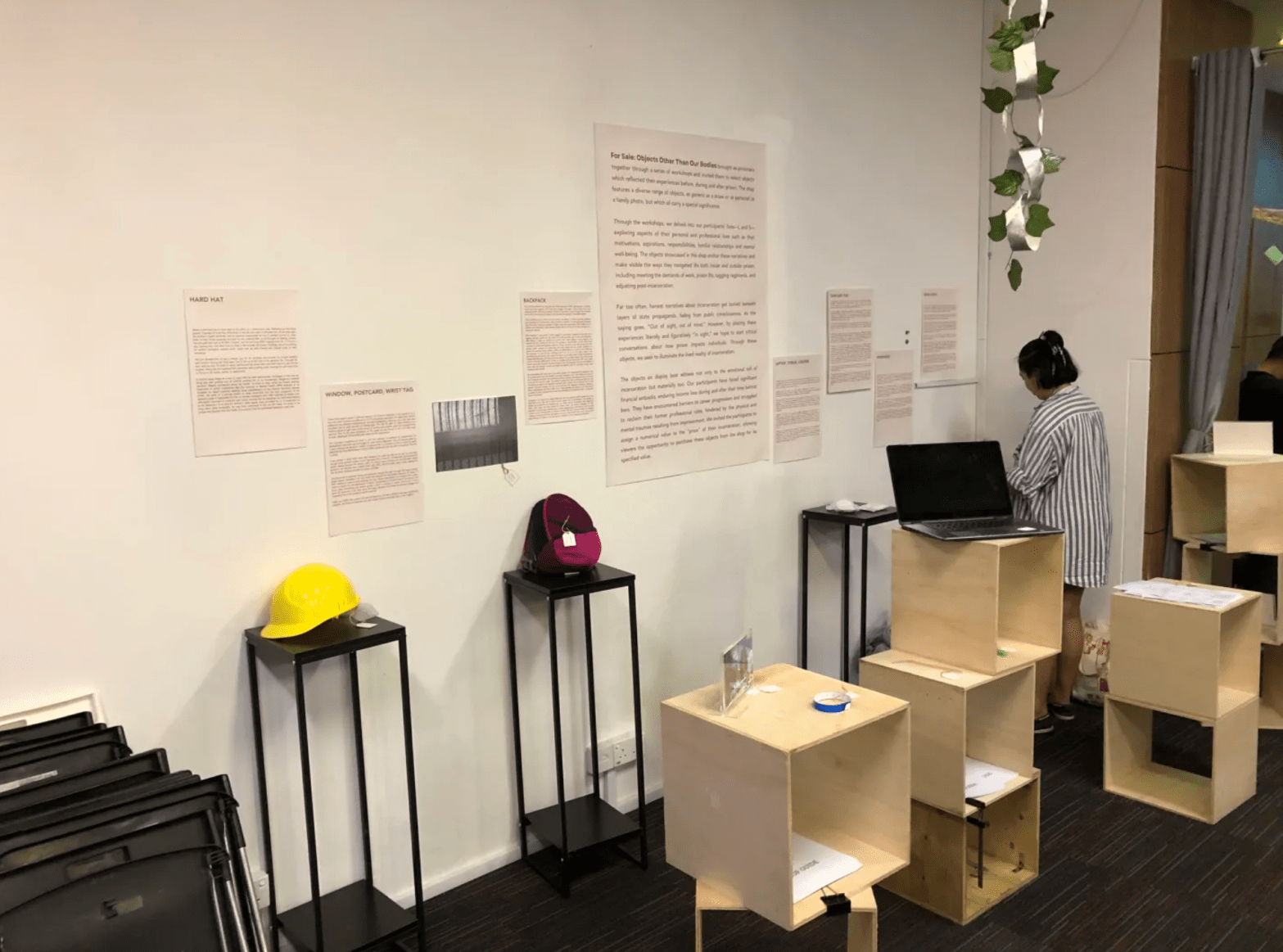
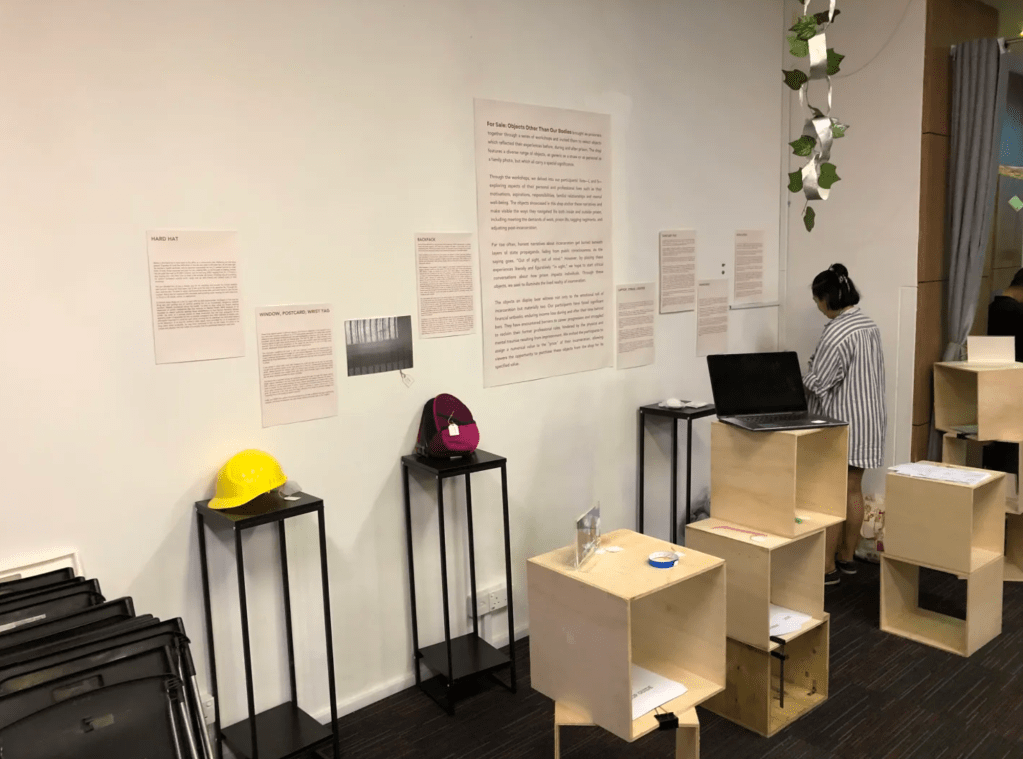
For Sale: Objects Other Than Our Bodies brought ex-prisoners together through a series of workshops and invited them to select objects which reflected their experiences before, during and after prison. The shop features a diverse range of objects, as generic as a straw or as personal as a family photo, but which all carry a special significance.
Through the workshops, we delved into our participants’ lives—L and S—exploring aspects of their personal and professional lives such as their motivations, aspirations, responsibilities, familial relationships and mental well-being. The objects showcased in this shop anchor these narratives and make visible the ways they navigated life both inside and outside prison, including meeting the demands of work, prison life, tagging regiments, and adjusting post-incarceration.
Far too often, honest narratives about incarceration get buried beneath layers of state propaganda, fading from public consciousness. As the saying goes, “Out of sight, out of mind.” However, by placing these experiences literally and figuratively “in sight,” we hope to start critical conversations about how prison impacts individuals. Through these objects, we seek to illuminate the lived reality of incarceration.
The objects on display bear witness not only to the emotional toll of incarceration but materially too. Our participants have faced significant financial setbacks, enduring income loss during and after their time behind bars. They have encountered barriers to career progression and struggled to reclaim their former professional roles, hindered by the physical and mental traumas resulting from imprisonment. We invited the participants to assign a numerical value to the “price” of their incarceration, allowing viewers the opportunity to purchase these objects from the shop for their specified value.
Hard Hat
Below is the hard hat S wore daily to his shifts at a construction site. Reflecting on this time period, S speaks to both the difficulties of the job and what it afforded him. At an early age, his mother’s health declined, and he became responsible for her. S needed income to cover both of their living expenses and pay for her medical bills, so he focused on making money. His job paid him well at $7,000 a month, but he had long shifts ranging from 14 – 17 hours a day, leaving him with little time to have a life outside his career. Thinking only of providing, he seldom socialised outside work, rarely met up with friends and missed many of their weddings.
The job allowed him to buy a house, pay for his wedding and provide his mother stability and comfort during her final years, but it did so at the cost of his personal life. Through the heat and the rain, he went to work, performed the same tasks and went home to care for his mother. Every day he repeated this mundane and gruelling cycle, leaving him with little time to focus on his needs, wants, or aspirations.
S started using drugs as a way to cope with his daily experiences. He began to feel that his drug use was getting out of control, putting him in an increasingly dangerous medical position. Deeply concerned about his health, he tried to stop using but feared seeking treatment at public institutions like the Institute of Mental Health (IMH) because of its mandate to report patients seeking drug rehabilitation to the Central Narcotics Bureau (CNB). He went to a private doctor to seek treatment, but the high pricepoint of the sessions made it impossible for him to receive consistent care. With nowhere to obtain safe, affordable treatment S could not quit using, causing him to overdose and ultimately leading to his detention. If he and his mother’s basic needs were provided for, or if treatment for drug users were accessible, he may have continued to live his life freely. S’s story is not unique and displays the sad reality of a country that has prioritised detention over care.
Price: $70,000
Window, Postcard, Wrist Tag
These three objects speak to different aspects of S’s time in detention. S was placed in an 8-man cell under constant surveillance by CCTV and security personnel. He made what minimal objects he was allotted multifunctional. He used toothpaste to shave as only a dry razor was provided, and to style his hair on visiting days. The mat he slept on often doubled as a cloaking device to gain what small amount of privacy was possible given the cramped living quarters. Due to the poor conditions of the space he was forced to live in S, like many inmates, developed chronic back pain which he still experiences.
The inhumane conditions he lived in and the constant surveillance he experienced are exemplified in the wrist tag and image of a cell window displayed. The wrist tag was given to S upon entering the detention facility. It reduced him to a number so that he could be easily identified by Drug Rehabilitation Centre (DRC) personnel and was worn throughout his time in prison.
S was placed in many cells, most with windows he could not see out of, but he was lucky enough to be granted access to one that gave him a view of a construction site beyond the prison. Seeing beyond the prison walls is a luxury many inmates are not afforded. While prisoners are allowed time outside their cells daily, many inmates report never seeing the sky, let alone anything outside the prison complex.
The postcards S received during his detention helped him get through this bleak period. These objects reminded S he was loved and allowed him the simple pleasure of colour. In DRC, nothing is made to look pleasing; as such, almost everything in an inmate’s life is grey, white or brown. On this experience, S states, “Everything is so bland, there’s no colours. You know, when something nice comes up like a card or a photo, it means a lot to me.” S was given 32 postcards in all. They gave him hope, allowing him access to pleasant images and reminding him of the family he would return to.
Sadly, as of 2020, the number of personal objects an inmate is allotted has been significantly reduced, and those in detention can only access a black-and-white copy of the original.
Price: $2,400 each
Backpack
Most of those detained for drug use serve their sentences in DRC imprisonment, a halfway house, and home tagging. How much time someone will spend in each vary, but often follows four timelines:
- Four months imprisonment, two months at a halfway house, and six months of home tagging.
- Two months imprisonment, four months at a halfway house, and six months of home tagging.
- Six months’ imprisonment and six months of home tagging.
- Twelve months of incarceration only.
These timelines and the criteria for how inmates are placed into them have been obtained from interviews by Transformative Justice Collective members of those previously detained. This information should be regarded as highly researched estimations. DRC officials do not disclose such information, often leaving inmates with no choice but to wait and hope for a favourable outcome.
After detention, S was placed in home tagging for six months. Unaware of when his home tagging regiment would end, this period in S’s life was filled with anxiety and exhaustion. After release, S spent six months as a courier under Yellow Ribbon’s work program. He required the job to serve out the rest of his sentence. It paid $1,600 a month, better than any other he could have acquired under the scheme. However, it was still less than what the general public received for performing the same duties and was wholly insufficient to support his growing family. Unable to afford the $400 dollars per month to rent a bike from the company, he used his own. Working from 8 a.m. to 6 p.m. five days a week in the gruelling heat and pouring rain caused his bike to break down often, further stretching his already tight finances as he had to incur the charges for consistent repairs. Each delivery had a short timeframe within which he had to complete the job leaving him with only a short window every day during his 45-minute break to rest. The long days, low pay and inability to know when his sentence would end made this period in his life extremely taxing, both monetarily and mentally.
His camaraderie with other men in the same program who understood his experience and his growing family kept him hopeful. S had two daughters and a wife waiting at home for him. During the weekends, he would take his family camping, ensuring he was home by 8pm so he did not break his curfew. The ability to spend time with his family gave him joy, and the need to provide for his daughters and give them a bright future motivated him to look forward and push through the rest of his sentence. His daughter’s backpack, displayed below, encapsulates this drive within him. It demonstrates the importance of his family’s presence not only in getting him through this challenging time period but also in giving him hope for the future.
Consistent in S’s story is the drastic effect that both the absence and the presence of care have had on him. The lack of care in his life caused him to self-medicate. His inability to access care pushed him to overdose and, as a result, end up in detention. What gave him hope, what made him look toward the future, wasn’t the terrible conditions of DRC detention or the low pay and long hours of home tagging but a community of men he could confide in and a loving family he wanted to build a life with. S was provided care despite meeting a justice system that attempted to remove it from his life. How might S’s story have been different if access to care was made as available to him as access to punishment?
Price: $10,000
Laptop, Straw, Lighter
“During this time in my life, what kept me going was the idea [of] shifting the public mindset on people who use drugs [to get] equal treatment just like any individual person. My difficulties were striking a balance between my drug use lifestyle while being a responsible mom to my children as well as doing my work.” – L
Displayed within this section are three artefacts representing L’s life prior to her incarceration: a laptop, a straw, and a lighter. Together, they encapsulate a transformative period where she served as a project coordinator, researcher, and activist.
The centrepiece of this ensemble is the laptop, a portal into L’s intellectual universe and the epicentre of her research and professional life. Driven by a desire to challenge prevailing stereotypes, she pursued her research on the intersection of sex work and drug use and sought to reshape the perception of drug users, emphasizing that they can be productive members of society. This laptop bears witness to her countless hours of work and embodies her diligence.
Adjacent to the laptop rests a straw and a lighter, representing drug paraphernalia. L embarked upon drug use as part of her research methodology, immersing herself to understand drug consumption within the context of sex work. It was during this time that she unexpectedly developed an addiction. However, L also describes this time in her life as an incredibly productive time, when she was deeply and lovingly engaged in her work. She notes that her drug use gave her a “boost” which allowed her to work long hours despite her age.
Reflecting on this period of her life, L speaks of it with mixed emotions. She accomplished many things she never thought possible, like presenting her work in Geneva as a spokesperson for her sex worker community. At the same time, a tinge of melancholy permeates L’s voice as she recognises that the joy and purpose she once found in her work are forever out of reach. “When I see this object, I feel sad because I know now I can never experience that feeling again,” she tells us.
Price:
$30,000 – laptop
$10,000 – straw
$10,000 – lighter
Sanitary Pad
Contrasted to her bustling and fulfilling life outside, L’s life in prison was very mundane, crammed in close quarters with three cellmates. The cell itself was small and hot, transforming into a sauna on humid days. In such a confined space, inmates had to adapt, innovate, and find ways to occupy themselves amidst the monotony.
Among the objects L brought to the workshops is a sanitary pad. Menstruation posed additional challenges for inmates. With only two sets of clothes allotted to each individual, they had to be incredibly cautious to avoid staining their garments during their periods. L would layer the sanitary pads to maximize coverage. If she ran out, extra pads were not so easily obtained, requiring a doctor’s memo.
She reveals that sanitary pads took on many other roles within the prison environment. For example, some inmates would roll up the pad into a makeshift tampon, while others would peel off the adhesive backing and roll it into a sticky ball, serving as a makeshift eyebrow wax.
Within the limited square footage of their cells, inmates ate, slept, and bathed. The lack of privacy and the compact space made cleanliness and hygiene crucial aspects of prison life. However, cleaning supplies are not provided in the set of standard-issued items upon entering prison. In the absence of a broom, L and her cellmates used the adhesives on sanitary pad wrappers to pick up fine dust and stray hairs from the cell floor.
Throughout our workshops, there were many instances like this, of inmates’ creative applications of the limited items available to them. Their ingenuity, born out of necessity and resourcefulness, extended to a range of items. Rubber elastics from underpants were pulled out and fashioned into hair ties. Threads pulled from blankets served as tools for body hair threading. Even the simple task of drying clothes presented its own set of obstacles. With only two wall hooks allowed per inmate, hanging wet towels, clothes, and underwear became a challenge. In the shadows of watchful officers, they resorted to rolling up their clothes and hanging them on the window grill to dry. Some inmates even crafted makeshift hangers out of paper. As L candidly remarks, “That’s how we tried to survive inside.”
L tells us that she didn’t know these tips and tricks when she first arrived. There is no survival manual for prison. Instead, she gradually learned by observing and communicating with different cellmates.
Although these improvisations defied prison rules, prisoners had to make do with limited resources to make their harsh environment more comfortable to survive in. Getting caught with these improvisations carried the risk of punishment, and any loss or damage to the items could lead to further repercussions. Everyday objects that are typically regarded as disposable in the outside world became invaluable commodities within the confines of prison.
Price: $5,000
Worksheet
Despite being labelled a Drug Rehabilitation Centre, our participants have expressed minimal evidence of encountering any meaningful rehabilitation during their time in incarceration. L noted that prison is far from being the optimal solution to reduce or eradicate drug use. Instead, it merely leaves individuals to fend for themselves, lacking the necessary support and resources to heal.
Displayed below are the worksheets provided to L as a supposed tool to address her addiction while in prison. We encourage visitors to peruse these worksheets and contemplate whether they would be considered useful or sufficient in overcoming addiction. L herself expressed a desire for the establishment of safe spaces that cater to individual needs, recognizing that each person has unique reasons for engaging in drug use. A one-size-fits-all approach is inadequate.
When it comes to prevention, the lack of accessible safe spaces to seek help becomes apparent. Existing institutions, such as the Institute of Mental Health (IMH) are required to provide names of patients seeking support for drug use to the Central Narcotics Bureau (CNB). So long as this reporting requirement exists, drug users in need of care are deterred from seeking it. The question raised by L is poignant: “Where is our safety?”
To this day, L continues to grapple with the urge to use drugs, as she feels that prison did not equip her with practical tools to effectively combat her addiction. She hopes that the government will recognize that current interventions, such as incarcerating drug users, are ineffective and fail to provide appropriate care. The solution lies beyond the confines of prison walls, where limited support and resources hinder genuine progress in addressing addiction.
Price: $10,000
Medication
Upon entering prison, L was promised access to a counsellor for support, but unfortunately, these promises were not fulfilled. L was assigned a Personal Supervisor (PS) who was meant to assist inmates in navigating prison life. However, L struggled to get a meeting with her PS, facing numerous excuses as to why they were unavailable for meetings.
When L did manage to secure time with her PS, the meetings took place in public settings where officers and inmates could see or hear them. These environments were far from conducive to having vulnerable discussions or seeking sensitive advice.
At one point during her imprisonment, L was sent to the psychiatric ward where she was physically restrained to the bed with metal handcuffs on both arms and her right leg. This practice, known as “Jesus Christ” among inmates, was an incredibly distressing experience. L had to rely on fellow inmates known as “cookies” for assistance with everyday tasks like eating and toileting. This loss of independence deeply affected L, who considered herself extremely self-sufficient before her time in prison.
Upon her release from prison, L faced significant challenges readjusting to life outside. Despite physically leaving the prison walls, she discovered that normalcy didn’t seamlessly return as she had anticipated.
L had intended to continue her work as a researcher and activist upon release, however, the unexpected and challenging circumstances she encountered during and after her incarceration left her unsure of her capabilities. Her experiences in prison stripped her of her dignity and independence, which resulted in a significant blow to her mental health and self-assurance. Depression took away her confidence and passion for work, leaving her to question if it was time to let go of her ambitions.
In the period immediately following her release, L had to undergo three months of tagging, wherein she was allowed to leave her residence for only three hours each day, from 12 pm – 3 pm. She had to accomplish various tasks within that limited time frame including running errands, attending psychiatric appointments, and attending compulsory urine tests. Despite living at home, she still felt imprisoned by the numerous restrictions.
The mental stressors that she faced upon release necessitated her continuation of psychiatric medication for some semblance of relief from her depression and anxiety symptoms. One year after her release, L is still in the process of finding a vision for herself and determining what she wants to do with her life.
Price: $50,000
Prison Cell
“We work together as one Home Team, and in partnership with the community, to keep Singapore safe and secure.” – Ministry of Home Affairs
This installation is a prison cell of about 2.3m by 2.3m in size.
It is used to house up to 3 prisoners. Inmates are given a translucent box to store their personal belongings which are limited to a plastic mug, a short toothbrush, toothpaste, two blankets, a straw mat, a towel, and up to 4 sets of white T-shirts and dark-coloured shorts. There is no furniture in the cell. Meals are usually served in a plastic tray. Coffee with bread (including butter or either strawberry or chocolate spread) is served in the evening at 5 – 6 pm for inmates to eat for breakfast in the morning. In every cell, there is a surveillance camera on the ceiling near the toilet. Inmates spend 23 hours in the cell and are allowed out for yard time or day room on weekdays, which lasts for one hour. Weekends are spent entirely in the cell.
Price: $8,050,000,000 – Ministry of Home Affairs FY21 budget
 Transformative Justice Collective